NAV BAR

HOMEPHOTOSABOUT

Wednesday, November 21, 2012

CoTA delivers in fine style

With many of the additions to the Formula One calendar in recent years flattering to deceive, it was easy to be skeptical of the quality of the new track in Austin before wheels had been turned in anger.

But the Circuit of The Americas bucked the worrying trend that had been set by the likes of Bahrain, Korea and Abu Dhabi and won the hearts of the sport as it immediately established itself as a favourite of fans and drivers alike.

Turn 15


A mixture of big elevation changes, fast sweeping corners and a low grip surface contrived to catch out many drivers over the course of the weekend, and despite fears beforehand about how good a race the track would throw up, the circuit produced one of the best Grands Prix of the year with action all the way through the field.

The trio of Hermann Tilke, Tavo Hellmund, and Kevin Schwantz, as well as everyone else responsible for building the track were taking a gamble by lifting corners from other tracks around the world. Remakes normally fall flat on their faces when compared to the originals, but the various replicas of corners worked well and contributed to a fantastic layout.

The Becketts section looked fantastic and produced a real test for the drivers, whilst the run-up to the first corner which was reminiscent of turn one at the old Osterreichring was visually stunning and produced good racing throughout the Grand Prix. Turn 19 was just as challenging as its mirror image at Istanbul Park's turn 8 and even the copy of Hockenheim's stadium section, which had looked noticeably out of place from the track maps produced some good moments and added to the circuit’s appeal.

There were a few things that could have been different. Turns 8 and 9 could be removed to allow a faster run and a better passing opportunity into the hairpin, which could be more open to allow a driver to get a good run on the car in front coming onto the back straight, making the opportunity to pass into turn 12 less reliant on good traction. Some work could also be done to the run-off areas, namely installing gravel traps at turns one, sixteen and nineteen to punish mistakes made in those areas of the track.

However those are only minor concerns and do nothing to take away from the quality of the circuit. All things considered, the Circuit of The Americas proved to be a fantastic circuit in a country that fully deserves to be a part of the Formula One World Championship and threw up a thrilling race for the fans that travelled to Austin.

It proved to be a worthy addition to the sport, and with a ten-year contract to host the United States Grand Prix, it looks set to provide many a good race over the coming years.

Stephen D’Albiac

Boot Scootin'

Having freely expressed my reservations along the up and down saga of the The Circuit of the Americas and their highly unusual approach to staging The United States Grand Prix, it's only fair that I now share my enthusiasm for the amazing weekend that eventually transpired in Austin.

US F1 fans should thank Tavo Hellmund for his vision, courage and belief in the idea that F1 not only belonged here, but that a worthy home could be created on Texas hill country just outside of Austin.    

Those who marshaled this incredible venue into existence did so in the face of staggering skepticism.     Merely weeks ago, the media remained rife with chatter dissing F1 in America and likening the effort to a train derailing in slow motion.  Manufactured conjecture and cynical commentary also suggested there could be some who did not want F1 back in the US.     

Despite the doubts and the naysayers, the grand spectacle which is F1 finally arrived at the newly constructed circuit under three spectacular crisp fall days.    The inaugural USGP far exceeded the expectations of many, including my own.   CoTA managed to pull it all together, and I gladly give them their due credit.    

Here are my impressions on the weekend from a spectator standpoint.    My observations will probably read as a litany of nitpicking, but work does remain at the circuit.  I hope my report serves to support those striving for long term success in Austin and remind US F1 fans that we have much to be thankful for.     

Friday morning arrival for shuttle transit to the circuit


Prior last week, one of my graver doubts surrounded the lack of transportation infrastructure.    The dilemma thus required fans to be shuttled in and out of the circuit from points around Austin.

Having been fortunate enough to purchase a reasonably priced shuttle ticket for the Airport Cargo location before they sold out, we enjoyed relatively painless transfer to and from the Grand Prix.    That is, until Sunday evening following the Grand Prix, where we encountered a rather long wait (over one hour).    

In hindsight, it is inescapable that CoTA and the City of Austin will have further work to do on this front.   News that next year's race already conflicts with Texas Longhorns football demands that.


Buses were plentiful (until race day) and comfortable


A bit of walking across protected lands was required from the shuttle drop to the circuit.    The distance was described as close to one mile, but to be honest I doubt it was quite that far.    No big deal.    Walking is a common prerequisite among the fabled Grand Prix circuits in Europe.    Spa and Monza especially.    

The park, shuttle, stroll to the circuit was somewhat complicated by an unexpected shift in session times.     I've no idea why morning practice, which normally starts at 10 am was moved ahead to 9 am, but we really missed that single hour.    I would suggest that if these times remain set for the future USGP, that CoTA get the shuttles up and running a little bit earlier.

due piedi

Approaching the circuit for the very first time, 7:30'ish Friday morning


First trek across the Grand Plaza, which lies between turns 15-19 


Unfortunately concessions proved to be one of the initial snags.     There were simply not enough vendors to handle the crowd.    Lines were long and required commitment.    

There were also chronic issues with credit card readers . . . apparently the CoTA site was not yet capable of handling the data traffic.    Ironically, the problem was probably more evident on Saturday, when the attendance was well below Sunday's race day quota. 

Given the obvious profit potential, I'm certain this will be much improved next year.   

. . . before the lines


Friday's stunning weather provided a glorious backdrop.     The tower is a nice touch, but a bit pricey at $ 35.00 (as we were told) for an hour or so on the viewing platform.    Perhaps the price will drop and I'll catch a practice session up there next year.

Beautiful, but overpriced tower
Photo:   Traci Carroll


Towering corner markers make for great
meeting points

Photo:   Traci Carroll

Photo:  Traci Carroll


Kimi Räikkönen was the first on track in FP1, the very first official session on The Circuit of The Americas . . .

He's never been here, but he knows what he is doing

The grounds are hopefully not completed.    Each afternoon brought a new showering of dust as the crowd grew and wind picked up.   This dust did get quite uncomfortable at times.     I don't know what sort of grass will grow on these hills, but here's hoping CoTA will do a bit more landscaping before next year's race.   Trees, shade, a place to escape the sun would be nice, too.   I'm certain that's a safe bet.

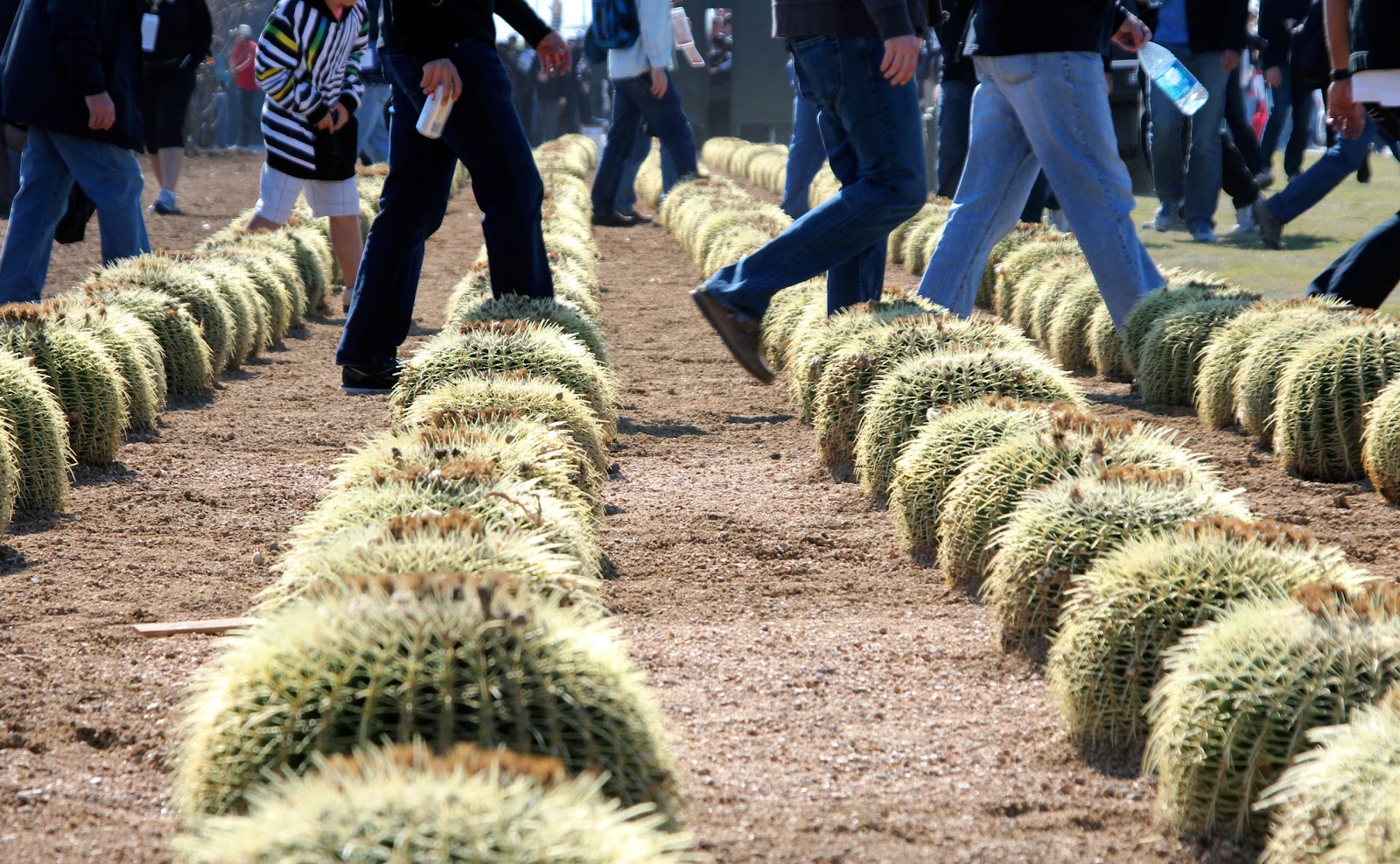
Orbs of cacti . . . looks great but location probably
needs a re-think if they are not to be trampled

Photo:   Traci Carroll


Somewhat a departure from standard road racing circuits, the Circuit of The Americas allows for expansive views across across the Elroy, TX landscape.    From our seats at 12, looking toward the rise to Turn 1, one can actually see almost six "layers" or unique segments as the circuit twists away from 12, disappearing around 17, with the high rise to 1 in the deep distance.    Looking left from 12, one can see most of the Silverstone Maggotts, Becketts homage from Turn 5 all the way up the rise to 10.

The real benefit, however, should be the draw this offers to US oval racing fans who have long complained about limited viewing at road racing venues.  The open design should help CoTA give roundy-round promoter Bruton Smith a run for the motor sport dollar.      

Distant views:  
The run up to and down from Turn 1 as seen from Turn 12.    

Note pedestrian traffic jam along the bottom of the frame
Given this design, the circuit could use more pedestrian bridges or tunnels.     The two bridges along the single path connecting Turn 16 to Turn 3 were horribly congested.     Bridges and stairs across road courses are normally boxed in so that those crossing can not see the circuit.    This is critical to keep foot traffic flowing.    

The stairs to these bridges are currently wide open.   Each time a car would pass, people naturally stopped to turn their heads and in the process stopped moving forward.    It was much like rubber necking on the freeway.     If CoTA can box these things in and sell ad space . . . they'd make a few bucks and we can all get where we are going quicker.
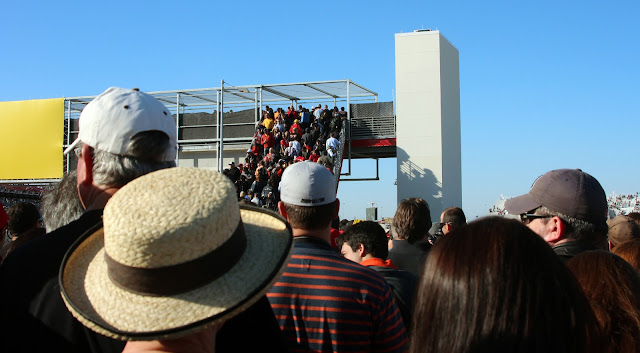
Pick out the lookie-loo in this picture
Photo:   Traci Carrol
The Grand Plaza features another interesting design element: a large amphitheater.  CoTA wisely chose to provide post racing entertainment to stem the tide of people leaving the venue at once.     

Collective Soul, performing Saturday afternoon


Race day finally arrived and the atmosphere was electric.     The myth that Americans do not care about F1 took a pretty hard hit, not only because of the number of people who showed up but for the energy and excitement they brought to the Grand Prix.   With a little help from the weather, F1 probably made a new friends on Sunday.    If you are interested in attending the USGP next year, I would suggest not waiting to the last moment to make your arrangements.

Dense, expansive crowd along the hill to Turn 19


Ironically much of the Internet discussion over the "detachable lens" controversy centered around the assertion that these lenses obstruct the grandstand views of others.     I found the argument naive, as those who take motor sport photos rarely do so while seated in a grand stand seat.   There are usually better angles elsewhere, not to mention the fact that it's tough to wield a large lens from a cramped, seated position.

Anyway, I tread down this bumpy return of the USGP one final time to relay a somewhat cynical observation.  How ironic that in reality there was indeed one item, an item not included on the prohibited list, which did obstruct grandstand views.     One can find them all over Texas . . .

Now that's what I call a hat


over sized, often obstructive, hats


By the way some women were dressed,
one would think they were at Churchill Downs


Ultimately, the circuit proved a fantastic stage for a gripping race; a duel decided "on" circuit by a driver who arguably delivered the most disciplined, determined drive of his career.    Ironically, he may have in the process gifted his former arch rival a real shot at the World Championship.      

Lewis' inspired drive spared us the "insipid" finger.    Not this one.
 . . . and thanks to everyone in Austin who championed Hellmund's vision, believing that F1 will work in the US.    Thanks for taking the chance.     See you next year!


Monday, November 5, 2012

How Seb got lucky in Abu Dhabi


Sebastian Vettel’s comeback drive in the Abu Dhabi Grand Prix was superb. Starting from the pit lane after his disqualification in qualifying, he produced arguably the drive of his career to come from last all the way to third place.


Vettel drove brilliantly on Sunday, and fully deserved to finish on the podium, of that there is no doubt. But he did benefit from a huge amount of good fortune without which he would not have been able to reach the podium.

Let’s go back to Saturday night to see where Vettel got the breaks that allowed him to gain 21 places on race day.

Car Changes

Having been put to the back of the grid for not having enough fuel left in the tank after qualifying, Red Bull took Vettel’s car out of parc ferme and modified it extensively. The gear ratios were changed and the amount of downforce on his car was reduced, giving him a higher top speed and giving him a greater opportunity to overtake in the race.

In addition Vettel’s engine was changed and he was able to start the race with a fresh set of hard tyres, which gave him a much better set-up in race trim than he would otherwise have enjoyed.

First Lap Incidents

There were two notable incidents from which Vettel gained at the start. The first was the turn one collision between the Force Indias and Bruno Senna, and the second at turn nine when Nico Rosberg ran into Romain Grosjean, leaving them both needing to pit for repairs.

This removed four cars which Vettel would otherwise have had to pass on the track, cars which would not have been easy to pass once the field had sorted itself out, and left Senna within easy reach of the Red Bull. This made his progress into a points paying position significantly easier.

These incidents benefitted Vettel to such an extent that by the end of the second lap the only cars separating him from the points were the Caterhams, Marussias, Toro Rossos and Michael Schumacher, all of whom (with the possible exception of Schumacher) the Red Bull would be expected to pass easily.

Collision with Ricciardo and subsequent pit stop

When Vettel was caught out by Daniel Ricciardo’s Toro Rosso behind the safety car and hit a marker board, forcing him to change his front ring, it looked as though he could’ve been facing disaster.

However, the chance to pit behind the safety car gave him the opportunity to change his nose, which was already damaged after a small collision with Bruno Senna on the second lap, and also allowed him to change to a set of soft tyres which increased his pace dramatically.

It meant that once the race resumed Vettel was right behind the cars he had already passed with ease at the start, and this time with much better tyres than the first time around, which meant it was easier for him to progress through the field at the second time of asking.

The Grosjean Factor

This was something not picked up by a lot of people, but in the laps before Vettel made his pit stop Romain Grosjean was running fifth and holding up a train of much faster cars which included Pastor Maldonado, Sergio Perez, Mark Webber and Felipe Massa.

Grosjean was lapping more than a second slower than Vettel before the Red Bull pitted, which allowed him to build up enough of a gap that he was able to rejoin in fourth after his pit stop, a position which may not have been possible had Grosjean not been holding up the pack behind.

Second Safety Car

Vettel made his second pit stop just two laps before the safety car was deployed for a second time for an accident between Sergio Perez, Romain Grosjean and Mark Webber. Not only did Red Bull time his stop perfectly in that it prevented him losing out dramatically by having to pit again under safety car conditions, but it also wiped out the 14 second deficit to Jenson Button which meant any work Vettel had to do to catch the McLaren was effectively done for him by the race being neutralised.

Whilst it is possible that Vettel could still have caught Button, and his pace at the end of the race once he had passed the Englishman suggested that he may have been able to catch him before the race, the safety car gave him the perfect opportunity to pass Button for the podium, and it was something he took full advantage of.

There is no doubt that Vettel drove superbly in the race, there is no disputing that. When he had to pass cars he did it quickly and efficiently, he put in some stunning laps before his second pit stop that allowed him to move into fourth and he took full advantage of the breaks he got to get himself a podium finish that few predicted he would be able to achieve before the race.

However, in a normal race, without the collisions, and without the safety cars, would he have had as much luck as he did and would he have progressed as far up the field as he did? The answer is probably not. He’d have scored a few points, but it would’ve taken a superhuman effort for him to get much further than the lower reaches of the top ten.

But that will not concern Vettel, whose drive was undoubtedly the performance of the race and whose podium ensures that he goes to Austin in two weeks time with a 10 point lead over Fernando Alonso in the drivers' championship.

Stephen D’Albiac

Friday, October 26, 2012

Winding down . .


D'Ambrosio's brief return, FP1 @ Monza.    He's since served as the first modern era driver to lap the new Circuit of the Americas in Austin, Texas.

Saturday, October 20, 2012

The Right Move?


There are a number of reports coming out of Italy suggesting that world champion Sebastian Vettel has signed a contract to drive for Ferrari starting in 2014, where he will race alongside Fernando Alonso.

Vettel, who is currently leading the drivers’ standings and is looking good to wrap up a third successive world title, has been backed by Red Bull for pretty much his entire single-seater career, and apart from one race with BMW Sauber in 2007 where he stood in for an injured Robert Kubica, has spent his whole time in Formula One with one of the two Red Bull outfits.

Since joining Red Bull Racing in 2009, Vettel has won 24 out of 71 races, taken 33 out of 71 poles and won two world championships. That is significantly higher than the amount of both wins and poles that Ferrari (with 10 wins, 4 poles and no title wins) have taken in the same period. In addition, Vettel is all but officially the number one driver at Red Bull.

So it would seem strange that he would leave the Milton Keynes-based team to join the Scuderia and race alongside Alonso who is, and still will be in two years time, the undisputed favourite in Maranello.

It’s also worth considering that 2014 will see huge changes to the regulations in Formula One. Whilst the biggest change involves the introduction of new engines to the sport and could well favour Ferrari over Red Bull, there will also be rule changes which focus on both front and rear wings and a potential introduction of some form of cockpit protection, which leaves plenty of room for the designers to get to work.

There is little dispute that the best designer in Formula One is Adrian Newey. That’s Adrian Newey of Red Bull. No matter what possible advantage the new engines could give to Ferrari, with Adrian Newey Red Bull will always have a car that will challenge and will most likely master the aerodynamic changes as well as anyone. So, if you’re Sebastian Vettel, why leave Red Bull to go to Ferrari just when F1 will go through a major change in regulations?

You could argue that Vettel wants to test himself against Alonso, widely regarded to be the most complete driver of his generation, and the only way of doing that is to go up against him in the same team. It could also be argued that Vettel still feels he has something to prove. Since being in Formula One, the German has always either had inferior team-mates (such as Vitantonio Liuzzi and Sebastien Bourdais) or the best car. By going to Ferrari, where he will not be given preferential treatment, will be up against someone equally as good as him and where there is no guarantee he will be driving a dominant car, Vettel has the opportunity to prove himself to be indisputably the best driver in the world.

In many ways it is to be admired that Vettel wants to go up against a team-mate as strong as Fernando Alonso. It is something that Michael Schumacher never did in his first career, and something that Ayrton Senna never even contemplated (infact he vetoed the arrival of Derek Warwick in his Lotus days on the grounds that he was too much of a threat to him). It is a risk that Vettel has shown he is willing to take and one that takes a huge amount of courage.

Seb could easily have waited at Red Bull until the end of 2016 (when Alonso’s Ferrari contract expires and at what will be 35 it is perfectly feasible for the Spaniard will decide to call it a day at that point) to try and get his foot in at Maranello, and no-one would’ve batted an eyelid. As a team that likes a big name driver Vettel would’ve been an obvious choice to succeed Alonso at the team. He could’ve gone to a team like Lotus as a stop gap and waited until Alonso’s seat came available. But he hasn’t, and for that he deserves huge credit.

Vettel’s move could go one of two ways. On the one hand, if he goes up against Alonso and gets the better of him, his reputation will be enhanced and he will go down in the sport’s history as one of the true greats. On the other hand, if Alonso beats him, and beats him soundly, then he runs the risk of having his reputation discredited and his achievements merely put down to having the best car.

Is it the right move? Only time will tell.